
Sustainability are our Core Values
At Victory Metals, sustainability is a core part of our journey from exploration onwards. Our Environmental, Social, and Governance (ESG) strategy is built on responsible development, proactive stakeholder engagement, and strong environmental stewardship.
Our ESG approach is guided by the Global Reporting Initiative (GRI), ensuring transparency and accountability across all aspects of our business. We are committed to:
- Integrating sustainability into our business model and decision-making.
- Measuring performance with quantitative metrics and clear targets.
- Driving continuous improvement and transparently sharing our progress.
Our approach is anchored in the GRI, with future alignment to other recognised frameworks (e.g., IRMA, AASB S2) as our ESG practices mature. We may also pursue independent assurance of key ESG metrics over time.
Our Materiality Assessment
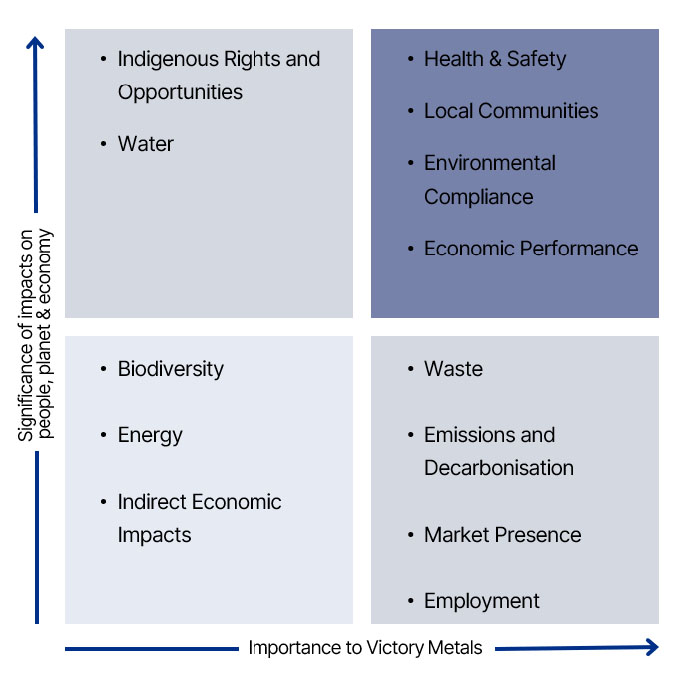
Victory Metals conducted a comprehensive materiality assessment, engaging leaders across our organisation to identify and prioritise key sustainability topics. This process considered the significance of each topic to both our business and our stakeholders, as well as their potential impacts on people, the planet, and the economy.
Thirteen material topics were identified and mapped based on two dimensions:
- Significance of Impacts on People, Planet & Economy
- Importance to Victory Metals’ Business
This assessment allows us to focus on the areas where we can drive the most meaningful impact and maintain transparency in our sustainability journey. Our Materiality Matrix highlights the priority topics that will guide our ESG strategy.

- Establish initial ESG practices focused on Health & Safety, Environmental Compliance, and Community Engagement
- Conduct Materiality Assessment to identify priority ESG topics
- Begin monitoring environmental and social performance (e.g., incident tracking, local engagement)

- Formalise ESG policies, including Environmental Management, Social Responsibility and Governance
- Implement a structured ESG reporting process (aligned with GRI)
- Expand local employment and training initiatives for host communities
- Begin measuring carbon footprint and exploring opportunities for energy efficiency

- Establish advanced ESG monitoring and reporting, including independent assurance
- Enhance ESG governance with Board oversight and regular reviews
- Develop advanced community investment strategies and supplier sustainability criteria
- Align with recognized ESG frameworks (AASB S2, IRMA) and consider third-party ESG ratings (MSCI, Sustainalytics)